
Cyberface3 and The VR Workstation
The Clearest Immersive Display Available
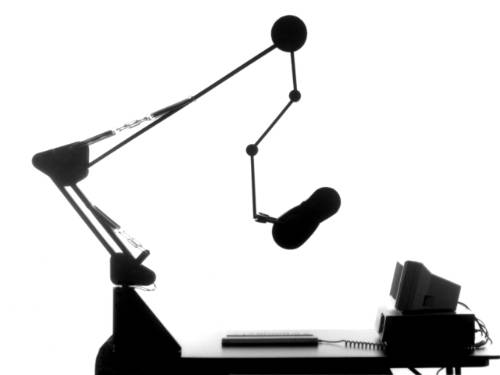
In the 1990's, The Virtual Reality Workstation was the lowest-cost, highest-resolution LCD-based display system available. It incorporated the new Cyberface3 display with a full-color resolution of 720 x 240 primary color pixels and simultaneous wide field of view. New LEEP optics gave the Cyberface3 twice the clarity of any VR display sold for under $100,000. In addition, the large eye lenses (71 mm clear aperture) provided plenty of eye relief so eyeglass wearers could use the display with ease. It was designed specifically for non-stereo applications, which required only a single video channel to be displayed. Even today, there are relatively few applications that necessitate the extra computing power and expense of stereoscopic rendering. The Cyberface3 readily achieved immersive and convincing Virtual Reality for entertainment, architecture, education, training, and other applications.
- 720 x 240 Pixel Resolution
- Lowest Priced HMD Available for its time
- Color LCD Display
- Wide Field Of View - Approximately 80 Degrees Horizontal
- Large Eye Lenses Provided Wide Angle With Plenty Of Eye Relief (Eyeglass Wearers Welcomed)
- Switch Selectable RGB Or Composite Input
- Accepted All Available Position Sensors
- Earphones Mounted For Binaural Audio
Wired Magazine Review
Gloves and goggles aren't the only way to navigate virtual worlds. LEEP Systems' Cyberface 3 Virtual Reality Workstation offers another way. Looking like a cross between a submarine periscope and a desk lamp, the Cyberface is actually an exquisitely counter-balanced back-lit LCD display that is strapped on your head and rests in front of your eyes. Once in place, every turn or movement of your head is transmitted down an RS-232 serial interface to a host computer (not included).
— Simson L. Garfinkle, Wired Magazine
Weightless Free-Moving Support
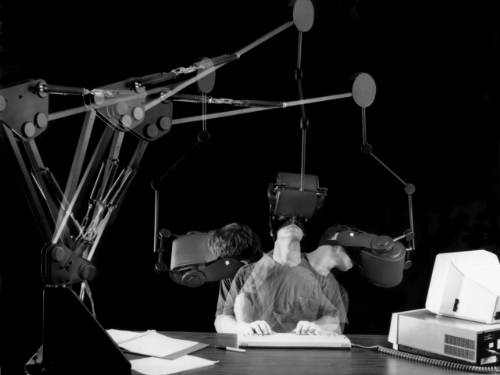
The Freedom Arm supported the weight of the display and, with its dangling "yo-yo", provided a full six degrees-of-freedom. The device was perfectly balanced and exceptionally comfortable to use. It clamped to the comer of a desk and could be held to the eyes by a manual guide bar or mounted to the head by a quick-release mask. The manual guide bar permited one-hand operation, which many users preferred to head-tracking. The mask was very inexpensive and sanitary. The workstation operator could wear it continuously and ''snap in'' to the Cyberface3 for working or navigating within cyberspace.
Head-Tracking
We incorporated high-speed head tracking into the VR Workstation. Users typically used the three rotational degrees-of-freedom (roll-pitch-yaw) and they could add the three translational degrees-of-freedom (x-y-z) if desired. The standard VR Workstation used analog output signals and provided for an optional RS-232 digital interface. The direct-wired sensors operated much faster than the traditional magnetic tracking devices used in virtual reality, dramatically improving head-tracking speeds and reducing lag time and the effect of magnetic materials for cyberspace applications.
Navigation
Four pushbuttons controlled navigation (1 = accelerate, 2 = decelerate, 3 = pause/resume, 4 = clutch) from the guide bar. Keyboard inputs could also be used for the same function. The result was an instantly learned method of navigation through a DXF-file world. The user flew left, right, up or down in the direction the head was pointing. The thrust and brake buttons determined the speed and the third button gave a toggled pause/resume flight. The "clutch" locked the world to the head, so the world could be turned to a new compass heading. Fly-through or walkthrough was entirely intuitive, accurate and easy. The action was: Fly; Pause; Look around; Go toward that; Slow; Pause; Resume. All navigation could be controlled by four push buttons and head direction.
Rendering
The latest Sense8 WorldToolKit (WTK) incorporated a driver for the LEEP Freedom Arm. The WTK enabled the developer to build real-time interactive graphics applications quickly, to design and texture complex spaces, and to import world designs in DXF file format. Sense8 provided development licenses for PCs (running DOS) for $3,500. Use of the workstation usually also required a graphics accelerator board, C compiler and DOS memory manager.